I’ve been in Guatemala for the past week and half, traveling the country, organizing my thoughts and itinerary. This is my first time in Central America and I have gone on a hiking tours, walked the cobblestone streets of Antigua, and run errands in Guatemala City. I have also been reading some articles of interest, including Kency Cornejo’s fantastic ‘Indigeneity and Decolonial Seeing in Contemporary Art of Guatemala’ for Toronto-based FUSE magazine (36-4, Fall 2013). I highly recommend this article as it has provided me with a much needed historical and theoretical platform for which to discuss questions of indigenous perspectives in contemporary art in Guatemala.
This past Sunday I arrived in Xela (Quetzaltenango) to meet my colleague, Boni, for the first time and today we finally began our first round of interviews. All four conversations were rich and exposed different opinions, personal memories, and represented different creative practices including; a curator and academic, a theatre artist, a magazine editor and a musician. I am still digesting the significance of today’s introductions and would like to thank our participants; Anabella Acevedo, Bonifaz Diaz, Valeria Ayeri and Lucas Imox.
Anabella received us at her beautiful, colonial-styled bed and breakfast, Casa San Bartolome and engaged us in an invaluable conversation about her life’s work as an academic in Latin American literature, and later as curator for organizations such as Fundacion Paiz and Ciudad de la Imaginacion. Anabella helped contextualize the development of Guatemala’s contemporary art scene, and the forms and languages that artists are using to challenge and make sense of concepts such as posguerra (post-war), memoria historica (collective memory?), and genocidio (genocide). She talked about the importance in Contemporary Art to create spaces for interpretation, that explore political issues in provocative yet figurative ways. She gave the example of the exhibit ‘Los Desaparecidos: Horror Vacui’, which congregated works from 25 Latin American artists which explored the systematic disappearances of political dissidents in Latin America.
From a historical perspective, an interesting observation Anabella made was the importance of the Centro Cultural Espanol’s role in forming a generation of curators, through fellowship programs that took place in the 1990s. The individuals that went through the programs have gone on to play pivotal roles in the consolidation of the contemporary art scene in Guatemala, which has historically lacked support from state institutions.
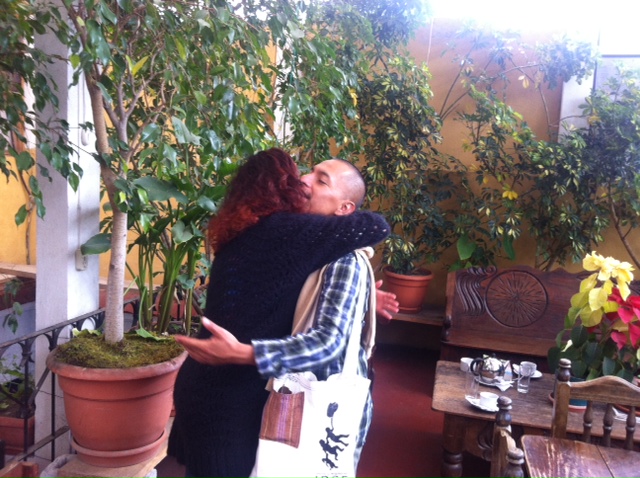
Boni and Lucas made similar connections with Fundacion Paiz, whose support of indigenous artists has been central in projecting and perhaps, emancipating indigenous perspectives into the nation’s contemporary art community. They explained that towns such as Copalapa and San Marcos have benefited from exposure to Fundacion’s cultural infrastructure, which has stimulated an important artistic community around Lake Atitlan.
Finally, Valeria, editor at Entremundos‘ bi-monthly magazine, shared her perspectives on the state of mainstream journalism in Guatemala, and subtle forms of censorship. She spoke of media industries that are monopolized in Guatemala and which support the government’s denial of genocide. She told us that Entremundos chooses to challenge these narratives through ‘Periodismo de Paz’- an approach which focuses on human interest stories that incorporate elements of memoria historica, by acknowledging the past and exposing ways in which communities are actively engaging in their futures. The example of the Center for Study and Documentation of Western Guatemala, featured in Entremundos’ current issue, really stood out to me. CEDFOG recognizes that in Huehuetenango, “the population has a rich, living oral memory of the history of the peoples in the region, and that this memory contrasts with the official version of the different periods of the construction of the country…” Among the projects the organization supports are a community library, and an initiative that trains youth in documenting oral histories of the civil war as experienced by people in the provinces of Quiche and Huehuetenango. Our conversation with Valeria ended with a powerful reflection on her own experience of the war. The TV commercials the government would produce romanticizing the army, the abuses at vehicle check points, and the stories of disappearances and rape.
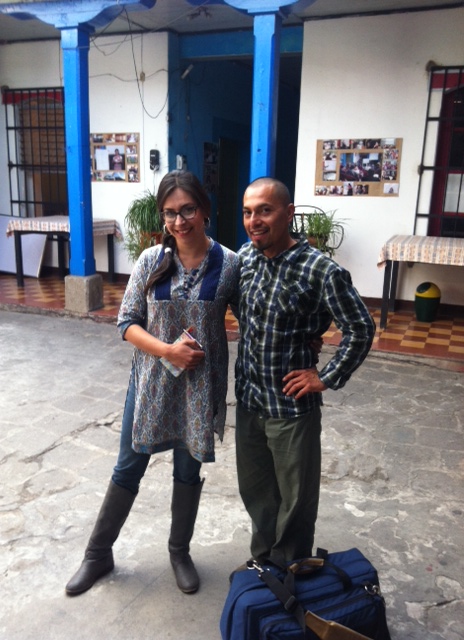
Today we’ll be speaking with MC Shaman, a hip hop artist and youth organizer based in Xela, and with Willy Barreno, owner of RED cafe and activist whose work with repatriated Guatemalans, has been recognized in Xela. I will be leaving for Lake Atitlan this weekend and am looking forward to getting in touch with people in the surrounding communities. If you would like to speak to me, please email me at demayo.j@gmail.com
 Julian de Mayo
Leave a comment